Sunday, August 11, 2019

Orchid of the day: Paphiopedilum dianthum

Paphiopedilum dianthum


This is our second oldest orchid, purchased in 2002. It is Arne's first Polyantha, which is the sub genus characterized by having multi-floral flower stems. This slipper orchid is a native of Southwestern China and Northern Vietnam.


A)  Above is one of three flowers that was fully opened on July 27th.

B) The entire orchid.

C) Three flowers bud on July 7th.

D) Up close.

E) The three blooms. Lovely spiraling petals.

This orchid has faithfully flowered annually every year. We look forward to see this orchid do the same next year. I hope you've enjoyed this post. Until next time, have a great week.


Saturday, July 27, 2019

Orchid of the day: Haraella retrocalla


Haraella retrocalla


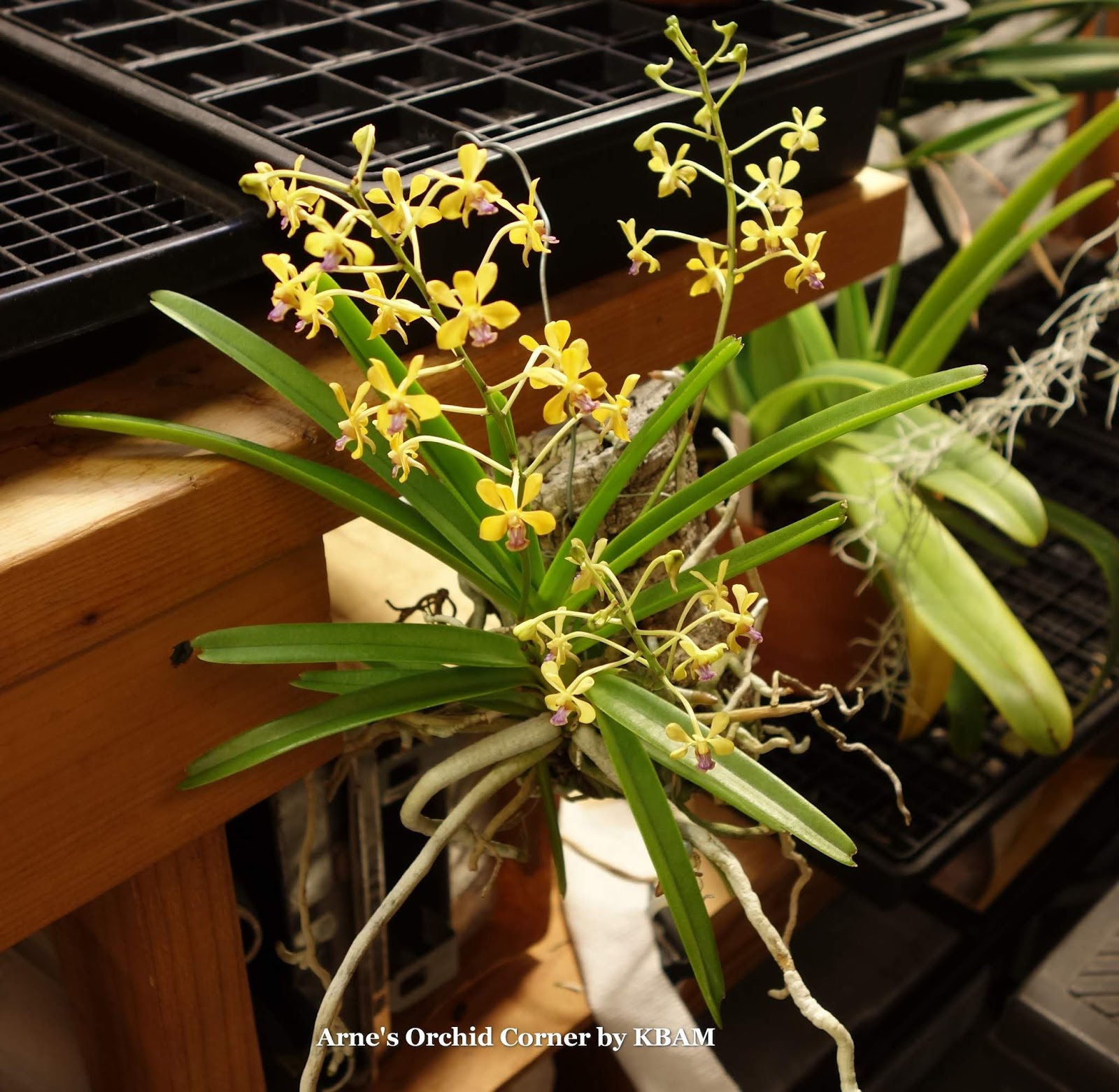
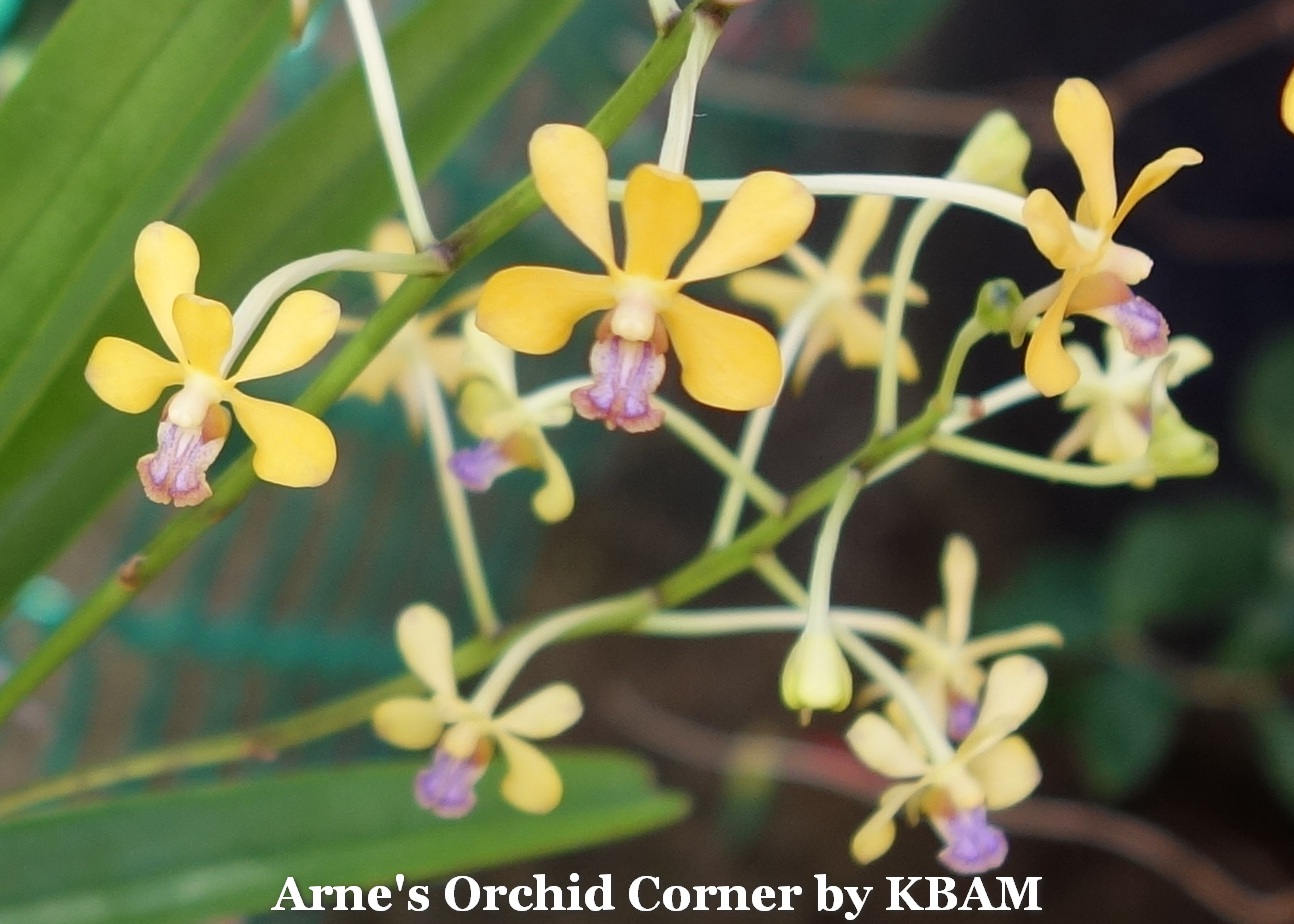
Haraella retrocalla is a vandaceous miniature epiphyte from Taiwan.  Considering the small size of the plant, the flowers are large, about 2 cm (almost an inch), with an impressive fringed lip. The flower is slightly fragrant. It is a warm-growing plant that prefers to spread its roots on a mount rather than to be potted.

After buying this plant last year in December, Arne decided he would mount it and I happen to have a coconut shell, left over after cooking chicken rendang, a Malaysian dish. I gave that to him and he was delighted to try using the coconut shell instead of the regular tree bark. He was excited to transfer this orchid from its pot and mounted it onto the coconut shell where today, it has attached itself so well that the nylon thread can be completely removed.

A) Immediately after mounting to the shell in December last year.

B) The Haraella retrocalla came with two flower buds when we purchased it. By the time Arne decided to mount it, the flowers were opened.

C) By July 7th, a new flower had emerged and a rather large one too, considering the size of the entire plant.

D) The roots have successfully adhered to the coconut shell.

E) A view of how small this Haraella retrocalla is in the hands of our grower, Arne.

I hope you enjoyed my post for today. I'll share another soon as I have been 'away' the last 2 weeks. I'm constantly taking new photos of our orchids but just haven't gotten to posting it as regularly as I would like. Until my next post, have a great day!


A beautiful miniature flower, gorgeous!

Sunday, July 7, 2019

Orchid of the day: Vanda testacea

Vanda testacea


I first posted about our Vanda testacea on July 9, 2017. We didn't have this many flowers and as usual with Arne's loving care, this clone has done very well this year. There are three flower spikes and forty flowers in total this time around.


A) Each flower has a rather prominent blue/purple lip which fades over time.


B) This orchid is native to Sri Lanka, India and throughout the Himalayas.


C) Basking in the Baltimore sun in June.


D) I cannot resist to show a photo of this orchid from 2017. It has certainly grown a lot in two years.


E) A closer look at the individual flowers.


F) Although Vanda testacea has the smallest flowers among the Vandas, each flower is well shaped and the purple lip makes the flower stand out.


As usual, I hope you enjoyed my post for today.
Until next time, have a great week.


Sunday, June 30, 2019

Orchid of the day: Vanda cristata

Vanda cristata


Arne acquired this plant in February 2018 as a seedling. It is  a compact Vanda which hails from Nepal and the mountainous regions of India and China. It prefers temperate to cool temperatures. This plant is blooming for the first time and the flowers emit a pleasant fragrance, especially in the morning. We believe the flowers may get somewhat larger over the years.

A) First time blooming in our care this June. Three flowers only.


B) A side profile.


C) Doing well in the wooden basket.


D) A closer look at the three individual flowers.


That's all for this post. Until next time, have a good week!


Sunday, June 23, 2019

Orchid of the day: Prosthechea mariae

Prosthechea mariae


Our Mexican orchid, Prosthechea mariae, formerly Encyclia mariae, is blooming with seventeen flowers today. See my post from June 28, 2015, which explains the name change following DNA anaylsis.

How this orchid came into our lives was quite interesting. Arne 'rescued' this plant in 2011. We were looking for plants for our garden and he noticed this sad and neglected orchid in a corner at a local gardening center. He wrote a nice piece about this in my post from July 5, 2014. Suffice to say, it has repaid us with beautiful flowers every year since.

It is a magnificent orchid which I sincerely think should be judged and awarded. Unfortunately, this orchid doesn't follow the schedule of the judging center in Washington D.C. It's has a mind of its own, quite independent...once again Arne couldn't take it to Washington D.C. this year, poor timing. It has grown a lot and by next year, Arne will most likely have to re-mount it on a bigger piece of cork.


A) Outside in full bloom last week, and still doing well today.


B) A closer view.


C) Anthony kindly posing with our Prosthechea mariae.


D) We have to keep this orchid is a nice area with some space to spread out.
And it has clearly spread out! I think it needs its own room.


E) First time flowering in our care in 2012.


I can't help but conclude my post today with a photo of what this orchid looked like in 2012. It has certainly grown!

Until my next post, have a great week everyone.


Sunday, June 9, 2019

Orchid of the day: Phalaenopsis parishii

Phalaenopsis parishii


This orchid originates from the eastern Himalayas to Indochina. Phalaenopsis parishii is hot to warm loving and is commonly known as Parish's Phalaenopsis, named after an English orchid collector in Burma in the 1800s. This orchid came to us in 2012 and had been growing in a wooden basket. It has adjusted very well since it was transplanted to a cedar wood plank. 

A) In 2016, growing in the wooden basket.

B) Arne had transplanted this orchid to a cedar plank recently. Doing quite well.

C) Back in 2015, Anthony showing how small this orchid was.

D) Zooming into the blooms.


I hope you enjoyed the photos of our Phalaenopsis parishii

Until next time, have a great week everyone.


Saturday, June 1, 2019

Orchid of the day: Vanda ampullacea formerly Ascocentrum ampullacea

Vanda ampullacea


Ascocentrum ampullaceum was first described by William Roxburgh as Aerides ampullacea in 1814. John Lindley moved the species to the genus Saccolabium and Rudolf Schlechter included it in his new genus Ascocentrum. Then, in 2012, taxonomists determined that they were really vandas after all. This perennial epiphytic orchid can be found in southeast Asia from Nepal to China (southern Yunnan) and India, including the eastern Himalayas. 

Arne got this orchid in 2017 as a large seedling from Motes Orchids. The first flowering was in 2018 with a short stem and very small flowers, about half an inch or less in diameter. But the flowers this year are all around one inch in diameter and they are so many, We estimated twenty flowers per stem and we had two stems. The flowers started to wilt by May 18th. Now they are all gone but we are looking forward to next year, hopefully the flowers will be just as beautiful if not more bountiful.


A) April 19, flowers and buds.


B) A few days later, more buds were opening up.


C) A closer look at the cluster of flowers.


D) By May 1st, all flowers were in full bloom.


E) The cluster of flowers does remind you of hyacinth-like blooms.


F) A final photo for today's post.

Until my next post, as usual, have a great week everyone.