Monday, January 1, 2018

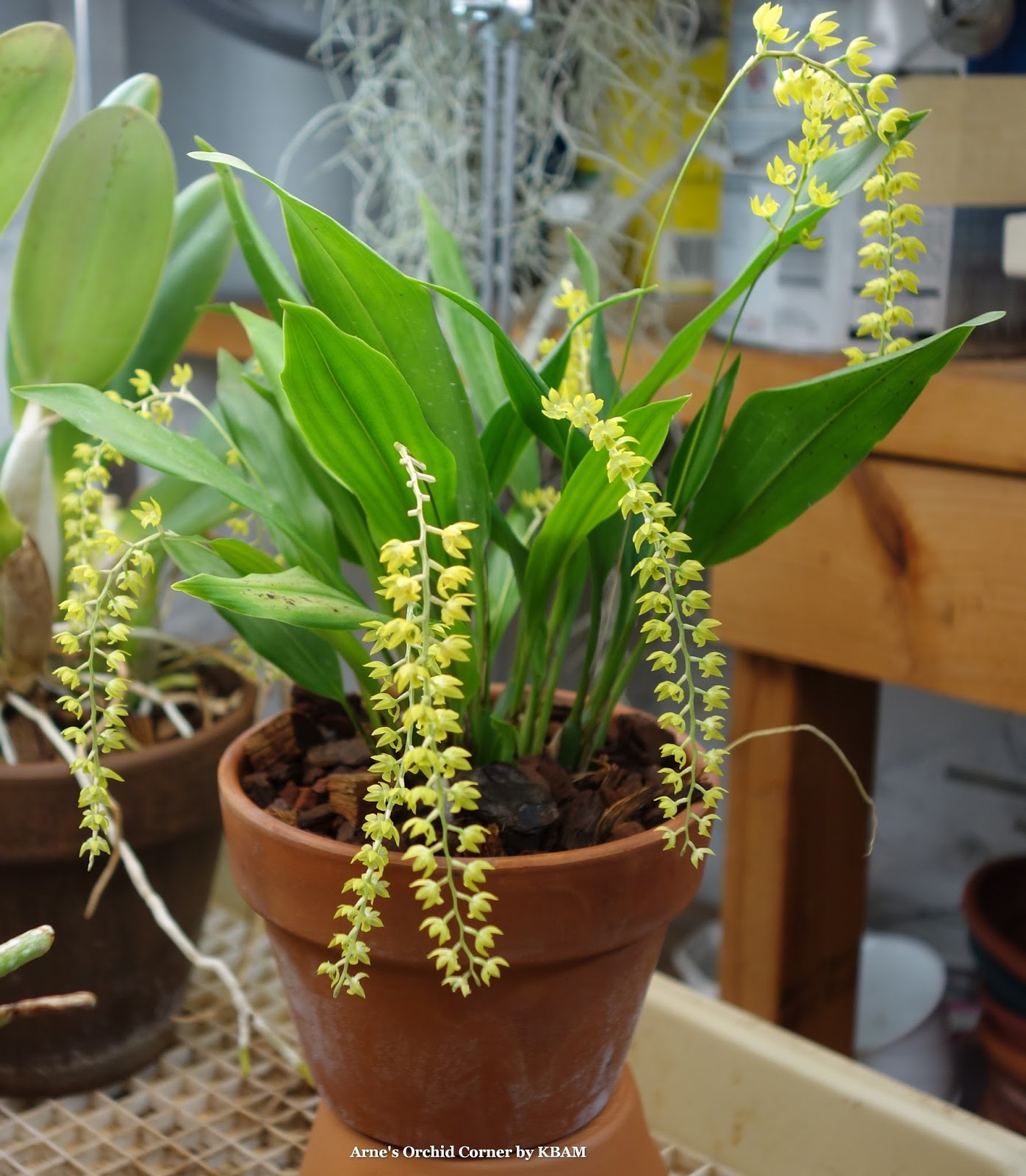
Orchid of the day: Dendrochilum uncatum var. uncatum

Dendrochilum uncatum var. uncatum


This orchid came our way last year and has been flowering since early November until now. This species is native to Taiwan and the Philippines. The height of this orchid is about 15 cm or ~ 6 inches. The flowers are about 1 cm and are bright yellow green with dark green shiny leaves.

There are two varieties of Dendrochilum uncatum; first is this one, Dendrochilum uncatum var. uncatum, where the hooked arms are attached at the middle of the column. Second is the Dendrochilum uncatum var. longispicatum, where the arms are attached on the bottom column.

In the wild, this orchid would grow on rocks and trees at elevations of 1,000 to 2,300 m. The common name of this orchid is "The Hooked-Shaped Dendrochilum", referring to the inward bent to the arms on the column.


A) A close up of the flowers.


B) By December 6, almost all of the flowers on ten inflorescences, were blooming.


C) Here is another photo taken on December 10.


D) A closer look at the individual flowers.


E) The entire specimen to conclude my post for January 1st, 2018.

Happy 2018 to everyone!


Monday, December 25, 2017

Orchid of the day: Cattleya cernua

Cattleya cernua (formerly Sophronitis cernua)


Our Cattleya cernua, formerly called Sophronitis cernua,  bloomed late last year and I featured this orchid in our first post for 2017, on January 7th. What a way to conclude the year with the same 'Christmas orchid'. This miniature orchid, originates from the Minas Gerais region in Brazil with bright orange-red flowers that can be a little larger than an inch (up to 3 cm). 

Most true orchid lovers know Cattleya cernua as Sophronitis cernua. The species that were formerly in the genus Sophronitis are mostly cool to cold growing orchids and growers of temperate and warm growing orchids tend to exclude this group from their collections. C. cernua, however, is a warm grower that is easily cared for if sufficient light is provided.  It should definitely be mounted as long as it receives water regularly. Because the roots like moist but airy conditions, Arne decided to inoculate the mount with Spanish moss, which drapes the roots and prevents desiccation when the sun is strong.


A) Buds were appearing by late November and by December 10th, four flowers were in bloom.


B) This miniature orchid is a regular bloomer and produced at least eighteen flowers. Here we have Spanish moss growing on the same bark.


C) By December 22nd, most of the eighteen flowers had bloomed.

I must mentioned that our C. cernua won first place for miniature orchid at the Maryland Orchid Society meeting at the show table, on December 21st, 2017. We hope to take it for judging one day at the national level. Timing is crucial as  the flowering and date for the meeting must coincide.

D) A closer view of our C. cernua. Simply love the bright orange red hue. Very appropriate for Christmas.


D) This orchid has been in our care since 2008. A lovely specimen.


E) A lovely close up the flowers to end this post.

Until my next post,
Wishing everyone a Merry Christmas, Happy Holidays and a Prosperous New Year!


Sunday, December 10, 2017

Orchid of the day: Cattleya Love Knot

Cattleya Love Knot


Cattleya Love Knot (formerly Laeliocattleya (LC) Love Knot), is a cross between Laelia sincorana x Cattleya walkeriana (abbreviated Lc. Love Knot). This specimen is from one of the two pots which we divided in 2015.


A) This was taken in early November. The second flower to the left, was still unopened.

B) A view from above.


C) By mid November, both flowers were in full bloom.

D) We took this photo November 19 out on our back deck.

E) Another close up.

That's all for this post folks. I hope you had enjoyed our Cattleya Love Knot.

Until next weekend, as usual, have a great week!


Sunday, December 3, 2017

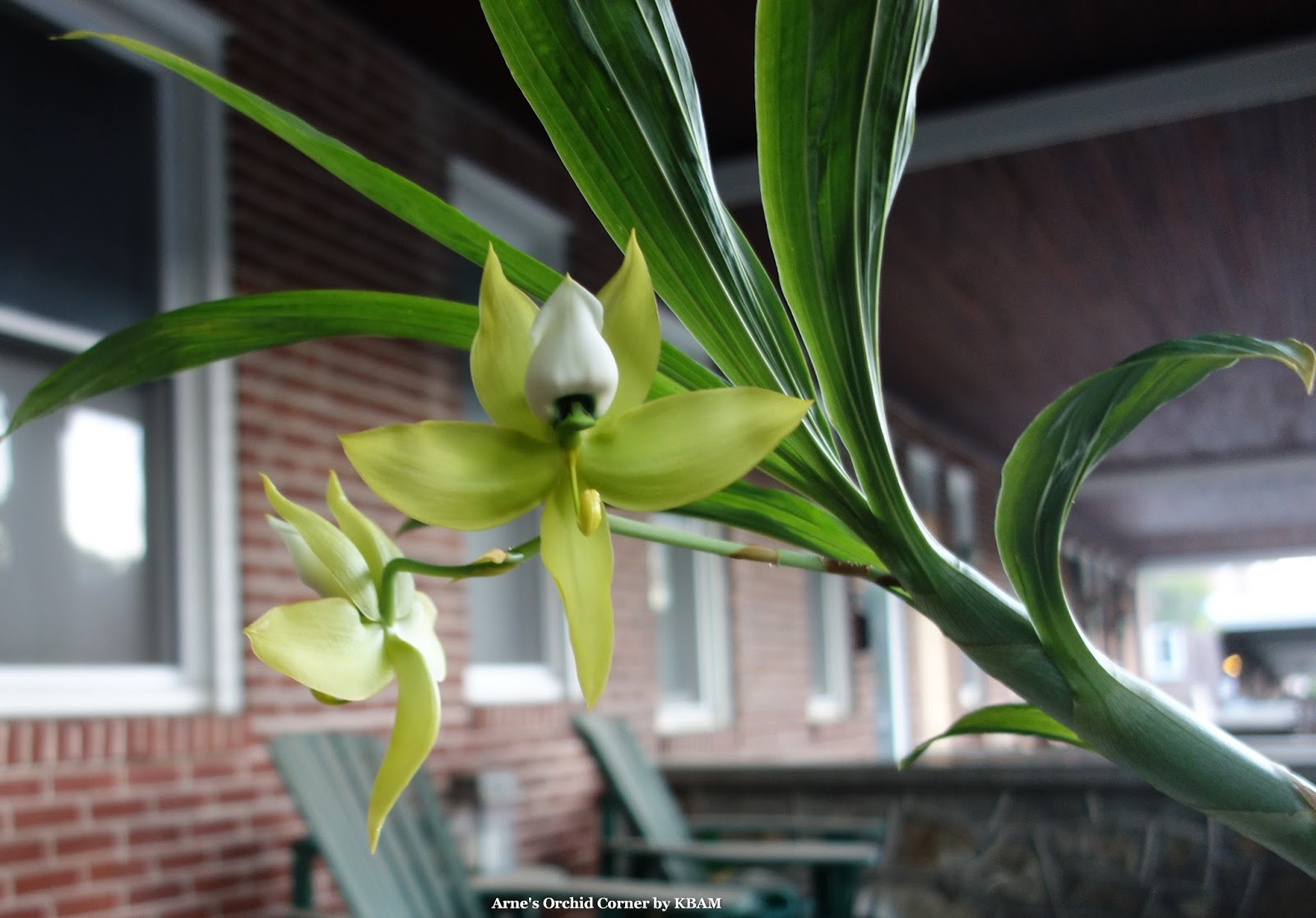
Orchid of the day: Cychnoches warscewiczii

Cychnoches warscewiczii


Greetings everyone. It has been a quiet November, not because we ran out of orchids to share, rather my 'orchid-guy' was under the weather and we had to make sure everyone was healthy and happy again. Arne is back and the orchids are being cared with love, once again.  Enough said.

Here is a new orchid in our collection, Cycnoches warscewiczii. I found it a rather odd looking specimen but its different and 'interesting'. Below is a nice introduction that Arne put together, I hope you will find it as interesting as I do.

"Cycnoches warscewiczii is found in Colombia as a warm to hot growing epiphyte (sometimes saprophyte) that loves lots of water, rain, nutrients and sun during the growing season.  When the huge pseudobulb is maturing in mid fall it produces two-five large flowers and wants no water for six months or so.  The flowers are non-resupinate, which means that they are upside-down.  Even more strange is that Cycnoches is one of the few genera that carry both male and female flowers.  The flowers shown here are male flowers and they are large, up to 5 inches (12.5 – 13 cm).  The somewhat funny-looking female flowers look like they are having helmets and develop only on very large and old plants because only a large plant can supply nutrients to and carry the seed capsules.  The other well-known genus that also produce both male and female flowers is Catasetum.

A) October 1st.


Finally, Cyc. warscewiczii and chlorochilon carry the largest flowers in the genus and are both known to emit a strong pleasant fragrance.  As we all know, when it comes to scents and taste, we all have our opinions.  Whatever scent Cyc. warscewiczii is supposed to emit, to me it only is reminiscent of some very synthetic candy aroma." Arne.


B) Two flower buds upclose.

C) Peculiar looking orchid buds.

D) By late October, both flowers were opening up.

E) Our upside down flowers.

F) A concluding photo of this interesting Cychnoches warscewiczii flower.


Thanks for coming back to my blog and I hope you have enjoyed this post. I plan to get back to me regular weekly posting next week.

Until then, have a great week and happy First Advent.


Monday, October 30, 2017

Orchid of the day: Bulbophyllum frostii

Bulbophyllum frostii


Our Bulbophyllum frostii, or our little Dutch shoes bloomed in July but as usual I captured some of the photos early in June. This orchid is originally from Vietnam and emits an unpleasant fragrance. Fortunately, I am not too sensitive to the smell...I do love this orchid, it is so cute and easy to grow with bright light and lots of water.

Once this orchid is happy, it really grows and spread out like a vine. We have divided this plant into 3 pots. Each of the division has produced numerous growth. This orchid is less than 10 years old. So for those interested, this is one of the easier orchids to culture.

A) A view from above on June 11.

B) June 11, only two Dutch shoes were fully developed.

C) We had divided this orchid into three pots and had given one to a friend. One of these pots had sixteen developing flowers.

D) Five little Dutch shoes up close.

E) Sixteen flowers on July 17.

Well, I hope you enjoyed the photos in this post.
Have a great week!


Sunday, October 15, 2017

Orchid of the day: Laelia gouldiana

Laelia gouldiana


This year our Laelia gouldiana produced five beautiful compared from last year's ten (November 16, 2016). But I'm happy to say that it was on loan for the recent exhibition of the 2017 National Capital Orchid Society Show in Washington, DC. It received a prize in its class.

This orchid is a real Laelia from Mexico. Laelia gouldiana is relatively easy to grow, especially in a Mediterranean-like weather. It does require bright light and temperatures in the range o68 – 85 °F (20 – 30 °C). The Baltimore summer heat is not ideal, so this orchid is mostly kept under lights in our basement until it cools down in late August.


A) September 17, five developing flower buds. My Anthony keeping watch.

B) A close up.

C) On September 24th, two of the blooms were opening.

D) Our orchid in bloom on October 12th.


We conclude today's post with this beautiful close up of the single flower of our
Laelia gouldianaHave a great week everyone.


Sunday, October 1, 2017

Orchid of the day: Brassavola perrinii

Brassavola perrinii


Our Brassavola perrinii, a South American orchid, is very floriferous this time. It has nineteen flowers in comparison to twelve last post, September 4th, 2016. Before that, we only had four flowers (November 14th, 2015). We have it on loan today for an orchid exhibition next week in Washington DC.


A) A zoom of one of the bloom today.

B) Early in September, flower buds were developing.

C) A closer look at the individual flower buds.

D) September 17, most of the flowers were already opening up. Emitting a mild fragrance.

E) A view from above.

F) A beautiful photo to conclude my post for this weekend.

Dear friends, this ends my post for this time.
I hope you enjoyed the photos of our Brassavola perrinii. Until the next post, have a good week!