Sunday, November 29, 2015

Orchid of the day: Cattleya Trick or Treat

Cattleya Trick or Treat


A) Anthony with our orchid October 25th, 2015.

B) At this time we only had 1 flower in bloom. The rest were still buds, 6 in total.


C) A different angle.

D) By November 18th, five flowers were blooming and at least four buds in development.

E) The brilliant orange color of these flowers really shines brightly in the sun. 

F) The entire plant stands more than 2 feet tall in height.


G) November 29. Still waiting for the last three buds to open up. In total today, we have eight flowers in bloom.

H) Cattleya Trick or Treat today.


Sunday, November 22, 2015

Orchid of the day: Brassavola nodosa

Brassavola nodosa


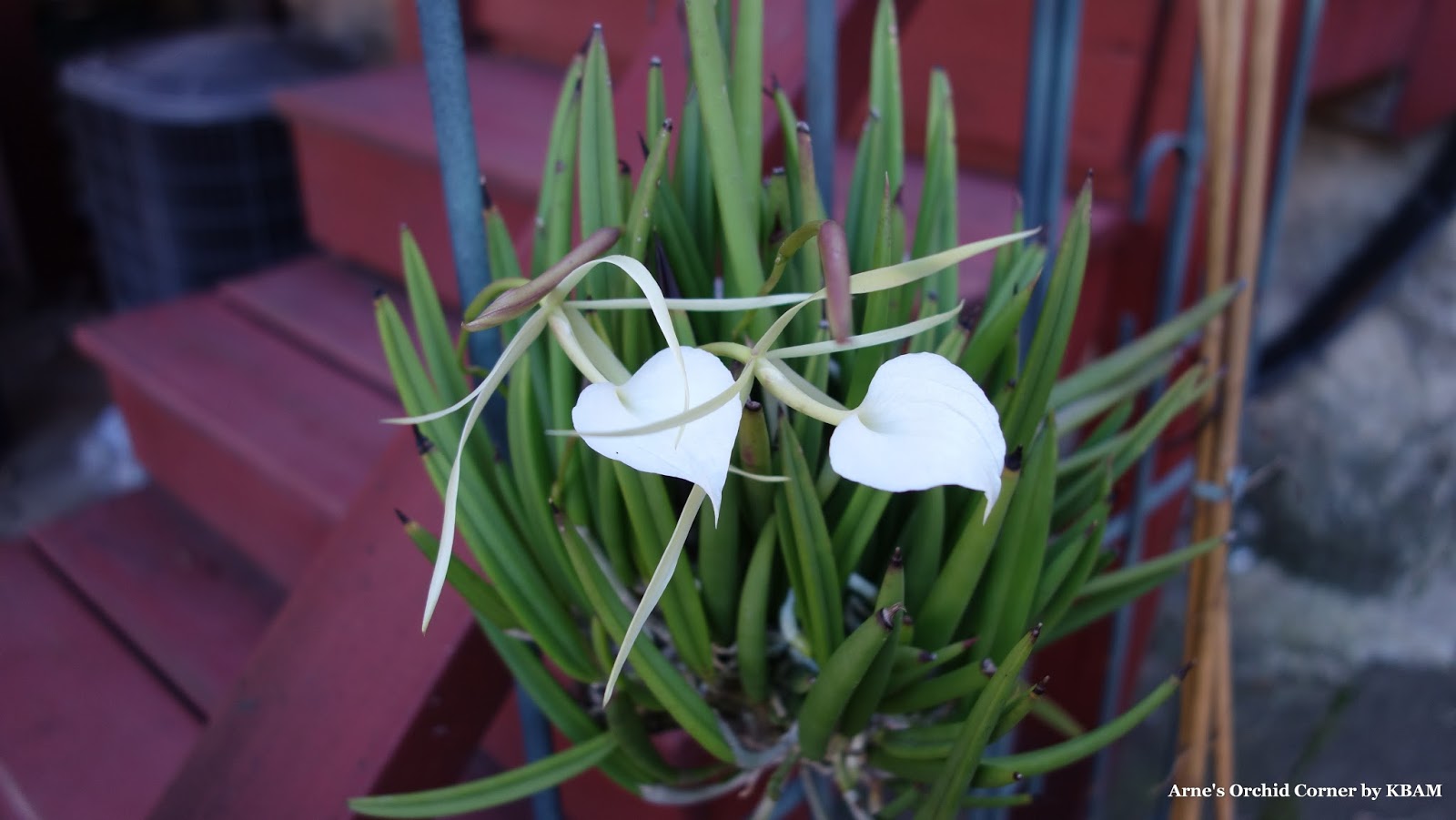
As promised, my new post today is another orchid of the genus, Brassavola, specifically, Brassavola nodosa, or as Arne calls it, the reluctant bloomer.


A) October 31st, four flower buds developed

This orchid is a native of Mexico, Central America, the West Indies, Venezuela, Colombia, Guyana and French Guinea. It is also known as "Lady of the night" because in early evenings, the flowers exude a citrus and gardenia-like fragrant. This fragrance is thought to attract moths for pollination, which is very likely.


B) By Nov. 1st, one of the buds opened. Normally we should have many more flowers but considering we wanted to 'dispose' of this specimen, this is a success!

C) Two beautifully shaped flowers, Nov. 7th.

D) To better capture the definition of these white flowers, we took the pictures outside with natural light. 

E) The span from petal tip to petal tip across is almost 4 inches across.

F) Our Brassavola nodosa tonight. All four flowers in full bloom and exuding a pleasant citrus fragrance.

I hope you have enjoyed the beauty of our reluctant bloomer. Who knows, it may produce even more flowers in the future. I'm certainly glad we kept this orchid around as Arne thought it was purely vegetative a year ago. Until my next post, Happy Thanksgiving everyone!


Saturday, November 14, 2015

Orchid of the day: Brassavola perrinii

Brassavola perrinii


The species within Brassavola have cascades of mainly white flowers that are more or less fragrant.  The most well-known is Br. nodosa, or Lady of the Night, that emits a strong but pleasant fragrance especially during the night (next post).  Br. perrinii cannot compete when it comes to fragrance but, at least according to Arne, the flowers are superior in shape and the species as such is much more floriferous and a specimen plant is quite a sight.


A) October 31st, 2015


B) November 7th, 2015. 


This plant arrived a little more than a year ago.  It had long grass-like growths and the vendor told Arne that he had decided to ship them in pots rather than mounted because of their awkward shape.  Arne mounted it as soon as he could because these plants really do not like pots.  That process disturbed it quite much though and that is why it only has a few flowers this year.  But it had to be done and from now on it will grow fast. 


C) November 8th. We took this photo outside to get natural light.


D) In the grower's own hands. Beautiful specimen.


E) View from above.


F) Upclose

Lastly,

Image result for fleur de lis paris

Sunday, November 1, 2015

Orchid of the day: Cattleya Love Knot (and new lights!)


Cattleya Love Knot


Here is one of our Cattleya Love Knot orchid flowering again late in September this year. After we divided the single plant, the new divisions have been producing two flowers at a time. I hope both these new plants it will produce more flower stems soon. Both are doing very well.

This is very inspiring and Arne has invested in purchasing a brand new light. He is quite motivated and has written a little something about this. 

New Lights and a Swedish Supergrower of Orchids ~by Arne

Now and then I check the web-site from the Swedish Orchid Society – you may want to think of it as my alma mater of orchid culture.  One day - I guess it was about one-and-a half-year ago I realized that one single person living in the south of Sweden was dominating the whole society.  In fact, that is an understatement because I think he is one of the greatest orchid grower I know of in the northern hemisphere.  His name is Tommy Ljunggren and you should check out what he is doing at his web-site http://ljunggrens.org/.

The reason why I’m impressed is that he is defying all problems associated with the culture of the most warm and light loving orchids at the 60th latitude.  That means culture of almost only Vanda in a sun-deprived and considerably cold location that is north of Newfoundland in the USA.  He has been able to achieve all this mostly because of persistence, interest and knowledge.  Nevertheless, since some 10-15 years ago there are also artificial lights nowadays that are so strong that extremely light-loving orchids can indeed be cultured even in a basement.  So from now on, we have our first super-compact fluorescent light fixture in our basement and we expect supergrowth.

To the right, a new 'strong' light has been added to our basement make-shift orchid  sanctuary. This light would be great during the winter months as some of our orchids are from the tropics,  for example our Aerides houlletiana, which is growing bigger in size.

I will conclude this post with two pictures of our very reliable Cattleya Love Knot. A new post will follow next week as we have a few up our sleeves! Until then, have a great week!


Sunday, October 25, 2015

Orchid of the day: Aerangis luteo-alba var. rhodosticta

Aerangis luteo-alba var. rhodosticta


Greetings friends! It has been a quiet few weeks, a combination of Summer hiatus as well as distractions of daily life. But I'm back now with beautiful updates of our home grown orchids. But first, let me share a nice picture of our orchids enjoying the Baltimore Summer.

A) Orchids hanging outside enjoying the breeze and sunlight of this summer.

Enough reminiscing about the Summer that has past. It is Fall now and let's enjoy this colorful season of the year. First up, our gorgeous Aerangis luteo-alba var. rhodostica.

In mid September this orchid developed two flower stems but unfortunately, due to the delicate nature, one of the stems broke while being handled. Much to Arne's dismay but the orchid is doing well.

B) September 13, 2015. One of the developing flower stem. No flower buds quite visible at this time.

C) By September 26, we can see distinct buds.

Here's a little story that Arne put together:-

We got our Aerangis luteo-alba rhodosticta in August 2014.  I knew it was supposedly very difficult to culture but it produced four flower stems with cascades of flowers as posted on this blog in February of 2015  According to me, the flowers were beautiful but disappointingly small in comparison to some pictures I had seen.


In May of 2015, the little Aerangis started to grow profusely.  This is when I realized one of the reasons why it is considered a difficult orchid.  The tip of the new leaves turned black and I first thought it was rot, which would have been really bad.  Later I understood that the tip of those leaves were about an inch too close to the fluorescent lights.  I have it hanging from a chain so it was easy for me to just move it down from the light a bit. 

In August it produced two flower stems.  This is when I realized how frail these stems are.  When I moved the orchids around, one of the flower stems broke totally when a leaf of another plant touched it.  Now I just hoped that the single flower stem left wouldn’t disappoint me further.  It didn’t!  This time the flowers are huge compared to before.  The largest of the flowers is close to 2 inches and there are 11 of them.  Their shape is also much better.  This is a wonderful little orchid, simply.~ Arne.


D) October 18th, most of the flowers are happily opened and larger than they were in February.

E) The orchid today.

F) Another photo of our Aerangis luteo-alba var. rhodostica with our adorable dog, Marcus Anthony.

Did I mentioned that we now have more orchids and extra lights and shelves? We are making more space in our little basement. How we'll manage, I have no idea but at least the basement will get organized!  Well I'll keep you posted!

Sunday, September 27, 2015

Orchid of the day: Eurychone rothschildiana

Eurychone rothschildiana


Did you know that Eurychone rothschildiana was called Angraecum rothschildiana? It is still the synonym. The flowers are about 2.5 inches in diameter and emit a slight fragrance. Although it was very mild to almost absence in our hand. It started to produce flower stems and buds in early August this year and now almost all the flowers, on one of the stem, are open and some have wilted. 


A) August 30th.The first flowers stem showing at least six buds.


B) The second flower stem is not very visible (to the right) here but we can see the roots shooting upwards.


We have 2 flowers stems; the first had seven flowers and the second stem, still has three buds waiting to open. This orchid is found in Ghana, Guinea, Ivory Coast, Liberia, Nigeria, basically in the central region of Africa. It loves moist and shady conditions to flourish. These orchids are monopodial and are small sized.


C) By early September, two beautiful flowers had emerged. A slight fragrance was noted but nothing too strong.


D) View from above. Here you can see the second flower stem growing to the right side of this picture.


E) The flowers up close. Note the delicate white surrounding the apple green color of the petals.


Below is a paragraph that Arne put together for me to share with you. Everyday is a learning experience for me. The flowers only last for about 2 weeks once it is open.

"The orchid family has more than 25,000 orchid species and no other plant family in the world can beat that.  It is therefore no surprise that every real orchid enthusiast once in a while suddenly stumbles upon a beautiful orchid species that he or she never heard of before.  That happened to me some nine months ago when I was searching for a small-sized orchid with relatively large flowers and found Eurychone rothschildiana.   I had simply never ever heard of it!  Eurychone rothschildiana is a rather small Phalaenopsis-like plant from Africa and has beautiful white and green flowers with a dark throat that disappears into its spur.  I gave it a try and I must say that it has grown surprisingly fast and is now awarding us with astonishingly large flowers on two stems.  Actually, the flowers are larger than average which makes me thinking of taking it for judging in the future.  I bought this plant from a nice botanical company in Montana and they advised me to have this epiphyte potted rather than mounted and I can see why.  I put it in a clay pot with large chunks of bark and it really seems to like it that way." By Arne.


F) The orchid, September 20th. The second flower stem is definitely much delayed in its development but here we can see the three buds.


G) Zoom in the see the details of each flower.


I hope you enjoyed the photos. This is a new favorite of ours!


Sunday, September 20, 2015

Orchid of the day: Phalaenopsis lindenii

Phalaenopsis lindenii


A) This is our Phalaenopsis lindenii with a total of eight flowers, September 20th, 2015.

We have had this orchid since March 2011 and it began to actively produce flowers in 2012 and hasn't stopped since. This orchid is endemic to the island of Luzon, the Philippines. Unfortunately, this beautiful orchid is in the endangered list due to deforestation.


B) We hang our orchid outside to enjoy the warm Baltimore summer, photo taken July 19th, 2015. We see a flower stem shooting to the left of this photo.

The fern attached at the top of the bark has really thrived over the years and the Phalaenopsis lindenii thick waxy leaves really developed, showing the beautiful 'batik-like' patterns.

C) Three flowers opened showing the purple colors and yellow specks within. Photo taken August 30th, 2015. Five flower buds still waiting to bloom.

I asked, as usual, for Arne to write a little piece about this orchid or orchid family. I think it is only fair that you readers get to hear what he constantly tells me. A little orchid knowledge from this post to you. Do enjoy the paragraphs below!

"Of the orchids sold commercially today, more than 90% are hybrids of Phalaenopsis.  Because of the mass production of these orchids with huge long-lasting flowers that have been made easy for everyone to have and even grow, it is easy to forget that the true Phalaenopsis species are wonderful plants that are almost getting extinct in nature.  Phalaenopsis lindenii is one of those orchids.  Although not a cold growing orchid, Phal lindenii likes it colder than most Phalaenopsis species and is considered difficult to culture. 

To be a Phalaenopsis orchid, maybe it can be considered difficult at least if you want to show it off in its full glory.  When I grow an orchid I always try to envision how it grows in nature.  Because of that I grow Phal lindenii mounted on a piece of cork bark in rather low light in our basement.  The temperature is around 70 - 77 °F (21 - 25 °C) in summer and 59 – 68 °F (15 – 20 °C) in winter.  A fern came with the plant and I have a feeling that they like growing together". By Arne.

D) A clearer view of the pattern within  the flower. Especially the top bloom.

E) A total of six flowers on September 8th, 2015.

F)  See the contrast from July (A) to today. From a single flower stem a beautiful cascade of flowers. The fern that grew on the top of the bark is really doing well.