Sunday, June 28, 2015

Orchid of the day: Prosthechea mariae, formerly known as Encyclia mariae

Prothechea mariae (formerly Encyclia mariae)


Orchid names keep changing due to the involvement of DNA analysis. One day you belong to one genus and the next you are not. Well that is the case with one of my favourite orchid, Encyclia mariae. It is now called Prosthechea mariae. Whether this will hold true forever, remains to be seen. Until the next DNA analysis or common sense...

This is a beautiful orchid from Mexico, by the way, LOVE Mexico. We noticed three inflorescences this year compared to two last year. It was quite exciting to see how many flowers we will get this year.


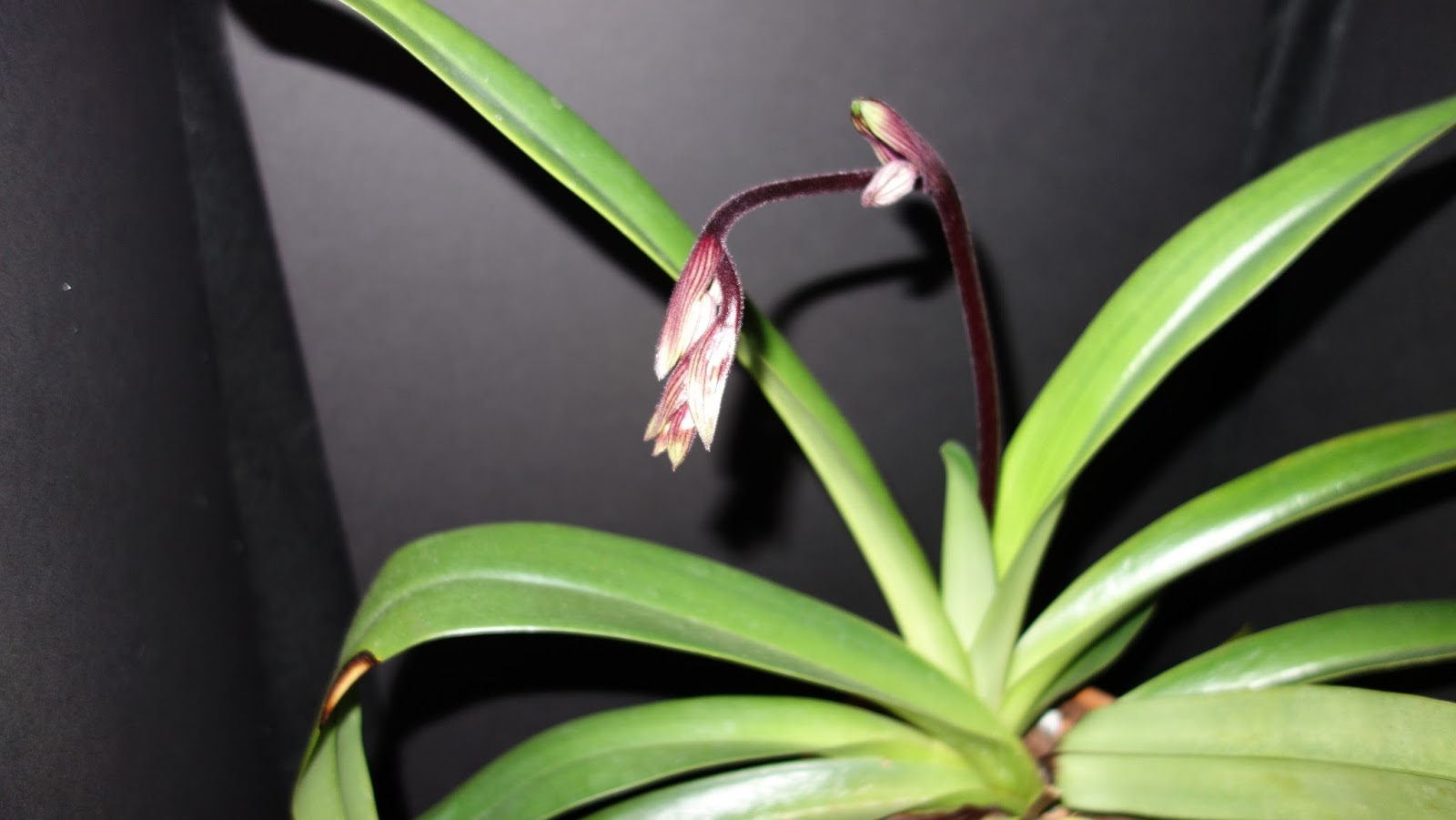
A) May 9th. Three very small inflorescences creeping out of the leaves.


B) It was still hard to see at this time.


C) By May 19th, the flower stalks or inflorescences were clearly elongating out. Left, right and to the top.


D) A different angle of the three flower stalks.

Here is a piece that Arne put together for the post today. Hopefully it will provide those interested with a little more background on the current evolution of the new name.

"I got to know the wonderful orchid Prosthechea mariae as Epidendrum mariae.  Then it was transferred from genera to genera and became Encyclia mariae, Hormidium mariae, Euchile mariae and finally Prostechea mariae.  It didn’t happen in that order necessarily but I know for sure it was transferred back and forth between some of these genera. Epidendrum once encompassed a huge number of species from Mexico and northern South America.  It was obvious that some distinction should be made between certain groups within Epidendrum so the division began into mainly Prosthechea and Encyclia.

Until today there are two orchids that form their own group and that are Prosthechea (Encyclia) mariae and Prosthechea (Encyclia) citrina.  Believe me when I say that they both belong elsewhere and will probably make up their own genus including these two species only. With respect to the culture, P. mariae wants to be mounted with daily watering from about May to October.  The temperatures in summer should ideally be around 75 - 80 °F (24 – 27 °C) or even somewhat cooler during the day and around 60 – 71 °F  (15 – 22 °C) during night.  After that it needs a dry rest during winter with almost no water and temperatures around 55 – 69 °F (13 – 21 °C) until the middle of March.  P. mariae always wants bright light without heating of the leaves". ~Arne~


E) By June 22nd, we have eleven flowers this year compared to eight in 2014. A beautiful specimen and worthy of sharing.

F) A view from the top. Lovely cascading blooms with a mild pleasant scent in the mornings.


Sunday, June 21, 2015

Orchid of the day: Paphiopedilum philippinense 'Khairul Bariah'


Paphiopedilum philippinense 'Khairul Bariah'


Just an update on our awarded orchid, Paphiopedilum philippinense 'Khairul Bariah'. For those following my blog, I first posted about this orchid on May 19th, 2014. Then I updated by announcing that we received an Award of Merit (AM) for this clone by the American Orchid Society (AOS) on June 7th, 2014 (see image below). 


Paphiopedilum philippinense 'Khairul Bariah' AM/AOS June 7th, 2014.


I am happy to say that this Asian slipper orchid is still doing very well. We have the privilege of having six flowers again this year. In fact the flower stem is longer this year by 6 cm or 2.4 inches. Since it has grown so tall, this beauty is occupying my window in our second floor study. It could not fit in our orchidarium in the basement.


A) April 15, the flowers are coming!

B) April 26. What a difference 10 days make!

C) April 26. At this time, it was hard to tell how flowers we will get this year.


As we chronicled the growth of this orchid, we were wondering if we could get six or more flowers this year. It was quite exciting to wait and see.


D) By May 9th, we saw at least five flower buds developing from the single flower stem.

E) A close up of the top end of the flowers stem (D). Three flowers were 'rolling' out on May 9th.

F) May 18, five flowers were fully opened. The last one at the very top is really taking its time to bloom. We were afraid it might not make it!


G) All six flowers in bloom on June 13th.

By June 10th, it was confirmed that the very last bud opened up and made the grand total of six flowers. We would love to have two influorescences or flower stems next time. If this were to happen, we may take this orchid for judging again! Who knows!


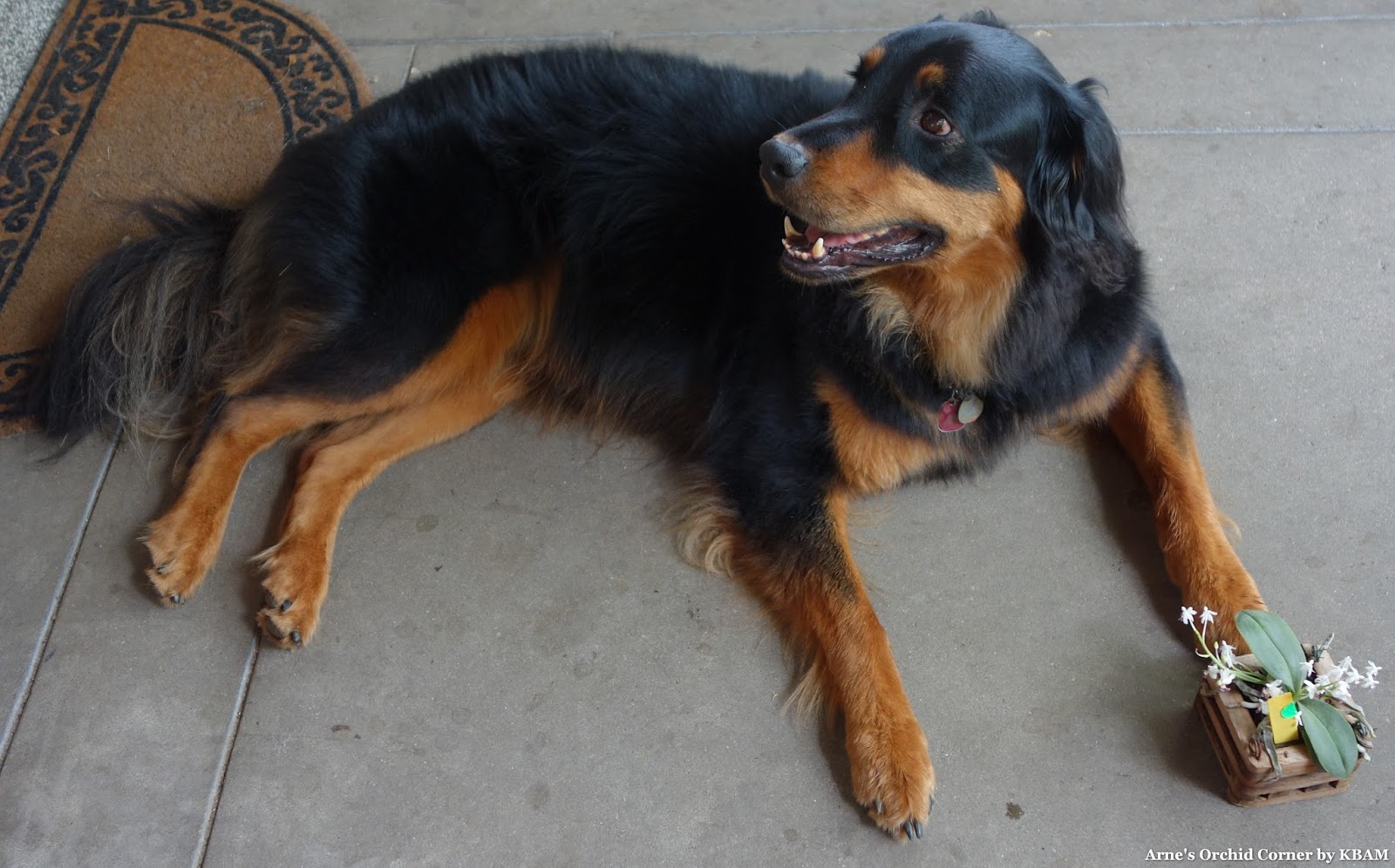
H) June 13, our obedient model, Anthony with our orchid on the back deck.

I) June 13, profile of the four flowers.

Saturday, June 13, 2015

Orchid of the day: Phalaenopsis parishii

Phalaenopsis parishii


This orchid originates from the eastern Himalayas to Indochina. A hot to warm growing miniature orchid and each flower is less than 2 cm across or 3/4 inches. This orchid is commonly known as Parish's Phalaenopsis, named after an English orchid collector in Burma in the 1800s.

A) May 9th, 2015. We noticed four flower stems developing.

We noticed that one of the roots decided to adhere to the yellow plastic label (A). We tried to detach it but it was a 'no go'. I guess that is why orchids are epiphytic. This orchid loves warm condition and partial shade. We keep this in our basement under lights.


B) May 9th, 2015. A view from the top.

C) By May 19, flower buds were growing on each stems.

D) June 7th, 2015. Here's Anthony providing perspective on how small this Phalaenopsis parishii really is. 

E) By June 7th, we had twenty four flowers. 

Clearly this orchid is doing very well since we got it in 2012. It is the third time it flowered in our hands and this year we successfully have twenty four flowers in contrast to nine last year.


F) Our Anthony posing with Phalaenopsis parishii on June 7th, 2015.


What a charming little orchid! Until next post, do enjoy.


Friday, June 5, 2015

Orchid of the day: Vanda Cherry Blossom 'Carmela'

Vanda Cherry Blossom 'Carmela'


Ascofinetia Cherry Blossom 'Carmela', a cross between  Neofinetia falcata x Ascocentrum ampullaceum, is a compact vandaceous type orchid that can be easily grown in bark or moss in pots or basket (see post dated May 26th, 2014). In this case, we kept it growing in this wooden basket and it seemed to do very well. 

However, this is no longer the current name of this orchid.  Since both Neofinetia and Ascocentrum have been transferred to the genus Vanda after DNA analysis. In short our orchid is now called Vanda Cherry Blossom 'Carmela'.


A) April 12th. We saw flower stems/stalks developing in the center of the orchid.

B) April 26th, the two flower stems/stalks showing the development of flower buds.

C) A closer view of the flowers buds.

D) By May 9th, some of the flowers were opening fully while some buds were still developing.

E) Another angle of the less developed flowers.

F) May 19th, almost all of the flowers were opened.

G) Almost double the number of flowers from 2014 .
H) View from the top. Many, many tiny Vandas in bloom

In comparison to 2014, which we had 50 flowers, this year we have around 95 to 100 flowers. Although some of the flowers have wilted today, those that remained are still beautiful. We have placed this orchid outside today, to enjoy the warmth of the Baltimore's summer weather on our back deck. May it enjoy the sun and flower even more next year.


Saturday, May 30, 2015

Orchid of the day: Cattleya Love Knot (formerly Laeliocattleya (LC) Love Knot

Cattleya Love Knot


I've posted about this orchid on February 8th, 2014. At that time, we called it Laeliocattleya (LC) Love Knot but now it is called Cattleya Love Knot. The seed parent is Cattleya sincorana and the pollen parent is Cattleya walkeriana. The orchid was doing very well that we split it into 2 pots and we are happy to say, both are producing flowers this year!


B) April 26th, 2015. One of the pots with 2 buds.

C) A side by side comparison of both pots on April 26th. 

D) A close up of the blooms on April 29th.

E) It wouldn't take long before the two buds on the left will open up.

F) May 9th, all flowers opened. What beautiful flowers.


Never a dull moment in my household with regards to flowering orchids. I have a few waiting to be posted in my blog. Some seem to be flowering at the same time. Another post will be following soon!

Monday, May 25, 2015

Orchid of the day: Dendrobium jenkensii

Dendrobium jenkensii


A) Two orchids on one tree fern, March 16th, 2015.

I wrote a post about the 'mystery' orchid growing on top of our Dendrobium jenkensii on March 16th, 2015. In photo (A), I wrote the 'mystery orchid as a Pleurothallis ghiesbreghtiana but an orchid expert corrected me that it it a Stelis quadrifida. I found at the time, the Stelis quadrifida fascinating and I felt I've convinced Arne to separate it from this tree fern and re-locate it. Hopefully we can enjoy the beauty of these two different orchids as they bloom at their optimal times. 


B) April 26th. Don't know how I missed but our Dendrobium jenkensii bloomed!

Roughly one month later, our Dendrobium jenkensii was flowering. We might have to wait a few more weeks before we can 'try' to relocate the Stelis quadrifida to another home.


C) A close up of the flowers above. Four buds still waiting to open.


I've asked Arne to put a little something about our Dendrobium jenkensii this time. He was so happy to see the buds developing as we have fewer flowers last year (see post February 2nd, 2014). He was a little worried this year because it didn't flower in February!

"Dendrobium jenkinsii belong to the Dendrobium section Callista.  They all want a warm summer with a lot of light and water but when fall arrives, water should be reduced to almost nothing but the plants should still receive a lot of light.  Then they need a period of cold temperatures for a month or two, still with a lot of light.   If all this works out they flower profusely in spring with a cascade of yellow flowers.  Needless to say they are all very tricky to get to flower, probably the trickiest that I know.  Dendrobium jekinsii is one of the most difficult, but its larger brother/sister Dendrobium lindley is even worse.  Nevertheless, they are worth all efforts." by Arne.

D) April 26th. A little closer now.

E) April 29th, 2015. They sure look good this year.

F) This photo clearly shows the contrast between the Stelis quadrifida on top, (minus the flowers), and the Dendrobium jenkensii at the bottom (with all its blooms).

I hope you've enjoyed my post today. I have been quite busy but have not stopped taking photos of our orchids. When I get a free moment, I'll post more. And I'd like to conclude by wishing you all 'Happy Memorial Day'.


Sunday, May 10, 2015

Orchid of the day: Tolumnia tequila sunrise


Tolumnia tequila sunrise


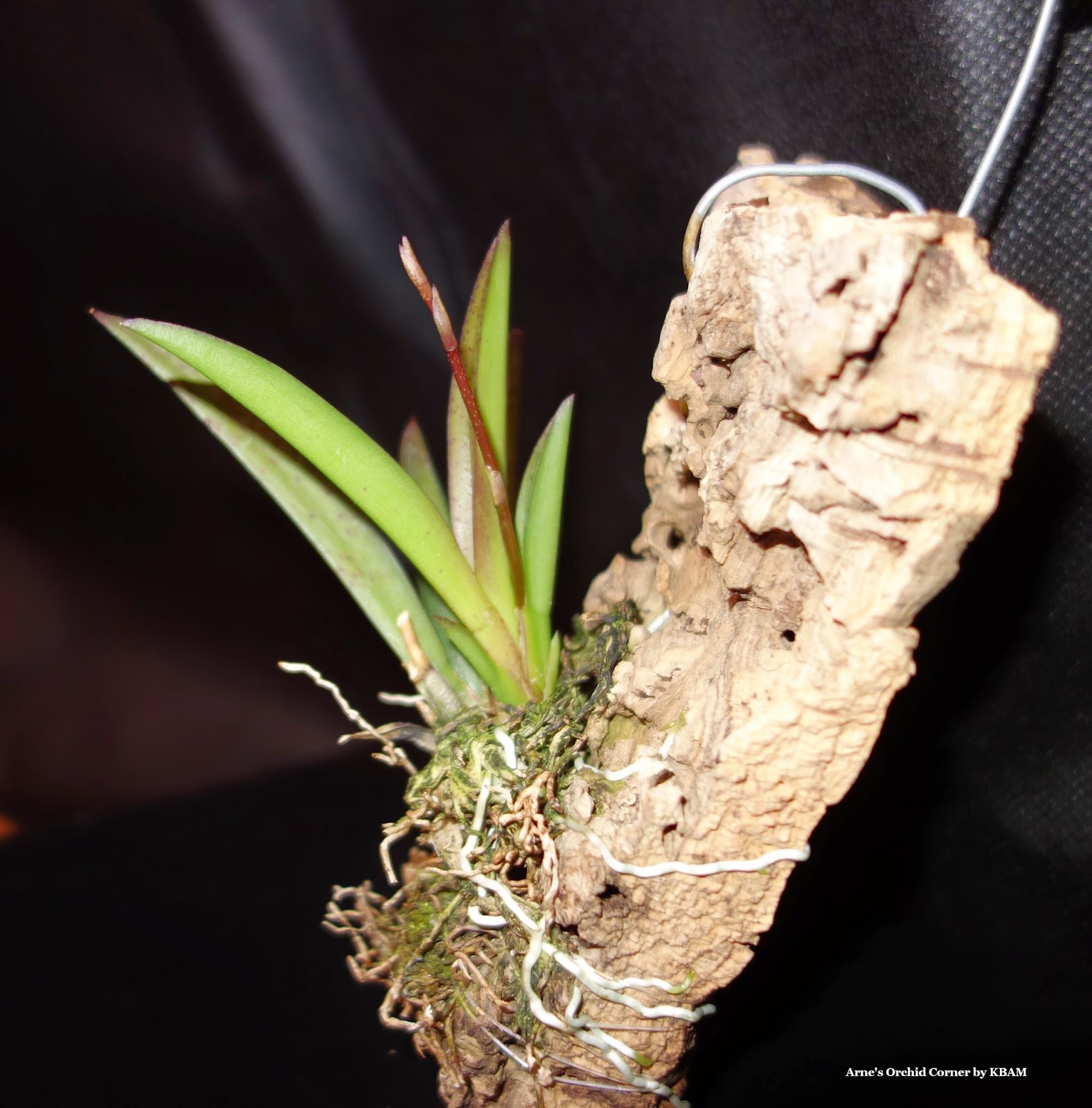
Once again, another orchid that does well cultivated mounted on the cork. There is a lot of love and labour involved in the cultivation of mounted orchids. Arne really devotes many hours on these mounted orchids and their successful flowering is the reward we both enjoy. I think it it worth sharing with other orchid lovers.

A) Dec 14, 2014. a flower stem was emerging.

B) The side profile of the young flower stem.

C) January 18, 2015. The stem elongating and small flower buds were developing.

D) March 1st, 2015. Clear development of the buds.

E) March 29th, 2015. We noticed at least five flowers breaking through.

F) With patience, on April 12th, four flowers were opening out, displaying their brilliant colours.

G) The beautiful flowers up close. They give the impression that they have a velvet texture.

H) Three buds still waiting to burst.

I) On April 26th, only three buds  left!

Today, all seven flowers are open. I really enjoy the intense yellow and deep red shades of this orchid. The similarity in shape to Tolumnia popoki 'Mitzi', also known as 'Oncidium Dancing Lady' is striking (post dated June 11th, 2014). But the colour of this Tolumnia tequila sunrise is so much more intense, in my opinion, of course.