Sunday, May 11, 2014

Orchid of the day: Cattleya walkeriana 'Kenny'.

Today's post is another 'from-buds-to-blooming-flowers' series. We followed the development of buds since early April this year and decided to see how many flowers would turned out. Arne said this orchid might not be what they say it is. He wrote a paragraph to expand on this 'issue'. All I know it is a Cattleya and it does exude a pleasant and tolerable perfume especially in the mornings and mildly throughout the day.


A) April 8th. We noticed buds creeping out.

B) April 8th. Buds were visible within the leaf. At this time only two appeared.

C) April 22nd. Next thing you know, more than a week went by and it turned out three buds were already well developed. We kept this orchid in our orchidarium in the basement.

D) The three flower buds at a different angle.

E) A few days later, the buds continued to developed.

Below is Arne's contribution to my post about this orchid. 

"Although I have several ‘natural-looking’ orchid hybrids in my collection, I always prefer species.  So when I visited Maryland’s annual orchid exhibition three years ago, I was really happy to find a white variety of Cattleya walkeriana for sale at Seagrove Orchids.  I have been very lucky with the walkeriana that I have at home so I bought it.  Linda Thorne at Seagrove Orchids did mention that ‘Kenny’ was a beautiful orchid but whether it was a true variety of C. walkeriana or a hybrid of it was not known.  My other walkeriana is mounted but this plant was sold in a small pot and had two buds so I didn’t dare to put in on a cork mount until it had flowered.  My first thought was that it was strange that the buds emerged from a maturing shoot.  In C. walkeriana the flower stem emerges in the form of a leafless shoot, normally without any leaf, from the base of the matured vegetative growth.  Then it was the fragrance; it didn’t smell like a walkeriana flower, simply.  Also, once ‘Kenny’ started growing on its mount I noticed how it attached itself loosely and not like walkeriana, which cannot be separated from the cork slab.  Now when I look at it I’m completely convinced that the plant is not a walkeriana.  To make a long story short, I searched for information about ‘Kenny’ and it is now established, supposedly, that C. walkeriana ‘Kenny’ is a hybrid called Cattleya Snowblind ‘Kenny’ and contains, in addition to walkeriana, also C. dolosa and C. loddigesii.  However, C. dolosa is a natural hybrid between walkeriana and loddigesi, which makes Cattleya Snowblind ‘Kenny’ a beautiful white primary hybrid between the two species loddigesi and walkeriana." By Arne Schon.

F) May 2014. The flowers have been in bloom since the beginning of May but this photo is taken today May 11th, on Mother's day. Each flower is about 3 inches from left to right.

G) Up close of the three gorgeous flowers. Now our Cattleya walkeriana 'Kenny' resides in our study window to get more light and space.

I hope you enjoyed this post and the beauty of these flowers. So far it has been 2 weeks since the flowers bloomed. They would probably last for another three to four weeks. Until next time, Happy Mother's Day.

Thursday, May 8, 2014

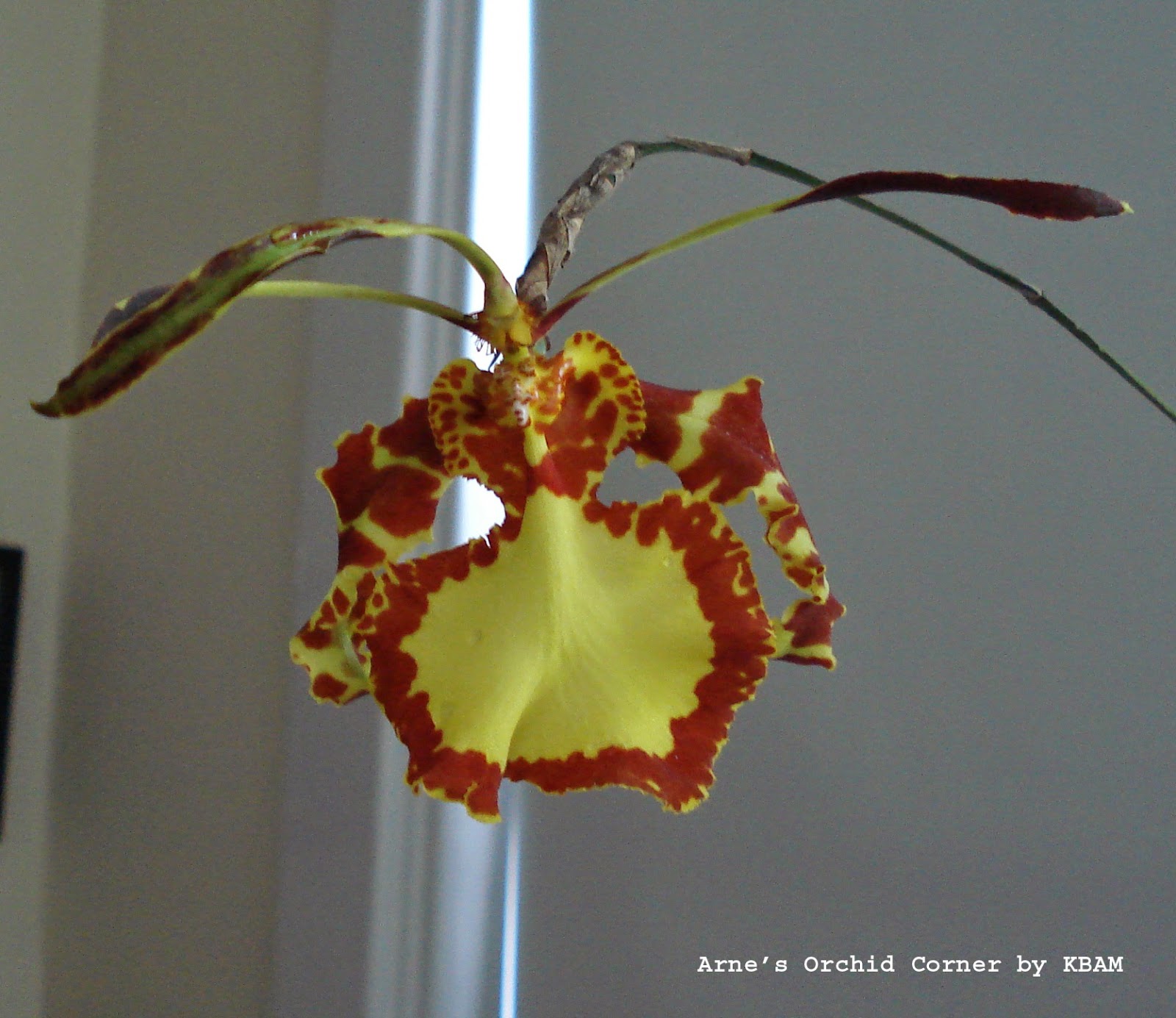
Orchid of the day: Psychopsis Mendenhall Hildos

This orchid is a primary hybrid i.e. only two species involved and it was formerly included in the genus Oncidium but was reclassified several years ago based on taxanomic differences. The genus Psychopsis is popularly known as "butterfly orchids" and native to Central and South America. This genus produces large elaborate flowers in shades of bright orange and yellow. 

A) April 9th, flower stems from the previous year.

Psychopsis should only be watered once a week if in a clay pot with bark mix, of course it depends on the surrounding humidity and temperature. This particular orchid produces well-shaped flowers and was awarded the First Class Certification (FCC) in 2004. According to Arne, this orchid is the easiest to cultivate in his collection. Since it requires minimal care i.e. watering and lots of light. We have it next to our study window all year round.
B) Close up of the stem.
Our Psychopsis Mendenhall Hildos is a reliable bloomer and we have had it for 3 years. This orchid flowered twice every year and the same flower stems keep producing flowers for more than three years.

C) May 8th, flowers emerged from the stems.
D) A beautiful afternoon to take a photo outdoors.
E) Up close from the top (Anthony's tail to the left).

F) Close up of the beautiful flower.

Monday, May 5, 2014

Orchid of the day: Paphiopedilum delenatii

It has been more than one week since I posted. I have been waiting and waiting for at least 3 different orchids to flower! I will be posting more photos of our orchids this week. Let me start with Paphiopedilum delenatii which was named after Delanat, a French orchid enthuasist of the 1900s. 

Paphiopedilum delenatii is native to the southeastern region of Vietnam at elevations of 800 to 1300 meters. These plants survive in granite pebbles and mossy tree trunks, usually in shady areas near water. Paphiopedilum delenatii was first discovered in 1903 when some returning French soldiers brought them back to France. This plant was believed to be extinct until it was rediscovered in the wild in 1993. 

A) January 29th. No flowers stalks were observed at this time. Note the mottled broadleaf. 
B) April 4th. Two flower stalks developed.  
 
C) April 7th. This orchid blooms in Spring with one or two flowers at a time.

D) April 28th. The flowers began to open up.

E) April 28th. Close up of the flower above.

F) May 3rd. Both flowers are finally opened. I decided to take this photo outside since the weather was nice.

G) May 3rd. More close ups of the flowers.

H) A super close up of a Paphiopedilum delenatii bloom. Note the pouch color that can range between pink and purple.

I) Paphiopedilum delenatii and Anthony on the back deck.

Tuesday, April 22, 2014

Orchid of the day: Broughtonia negrilensis x Laelia crawshayana

This is an orchid that resides in our orchidarium in the basement for most part of the year. But once the stalk starts to shot out and budding begins, Arne takes it up to our study window for more light and attention. These photos were taken December last year.

A) Four flowers emerged from the orchid stalk last year.

B) Up close of Broughtonia negrilensis x Laelia crawshayana bloom.

C) Currently there are no flowers on this orchid as yet. A new stalk started to grow a few weeks ago. It might take another month or more before it starts to bloom. Pretty exciting times.


Monday, April 14, 2014

Orchid of the day: Laelia sincorana

The flower from Laelia sincorana was so vibrant last year (see photo A below). I kept monitoring the development of the flower this year and boy, do I have a lot of it! Here's the ones I finally selected for this post. Laelia sincorana originates from the Brazilian Sincorana plateau in the state of Bahia. This miniature orchid is either lithophytic or epiphytic and grows on rocky ledges and on the trunks of Velloiza bushes. Although the area is rather dry and barren, the high altitude allows fog and condensation on a daily basis to moisturize the plant as well as providing excellent ventilation. L. sincorana requires a very dry rest in the winter in cultivation and does best mounted on cork in a bright and airy location. We have ours mounted on cork and hanging in our study window.


(A) Laelia sincorana from 2013. The orchid was very small in size and notice a slight imperfection on one of the top petals.
The flower is between small to medium (10 cm across). The flowers have very vibrant colors and well formed. This year I followed, once again, from bud to blooming flower. Before I go any further, we had hope there will be more flowers but we ended up with one again.


(B) This photo was taken April 3rd. The plant is slightly bigger this year and the flower stalk is also longer. It was really exciting to see how the flower would look like.

(C) Finally April 9th, the petals opened!

(D) After much anticipation, we have our bold and brightly colored flower. But we see the imperfect petals again. This time in both top petals.
The imperfection observed here is probably due to this particular clone. Arne is dismayed but not disheartened. Maybe next year it will be fine. He took great care to ensure the flowers would not get damaged when he was watering the orchid. Well, better luck next year (or he'll just buy another one!). It was an adventure but nothing can be perfect all the time! I'm sure this happens a lot and hopefully we'll learn from this experience.


Sunday, April 13, 2014

Ochid of the day: Dendrobium jenkensii 2014

Today I'm posting about our Dendrobium jenkensii. I followed the progression from no flowers to buds and finally to blooming flowers. Right now there are four flowers and another four buds are coming through. I'll post an update when the remaining buds start to flower.


A) This photo was taken March 19th at the sign of the first few buds. You can barely see it.

B) By April 3rd, one of the four buds bloomed. When Arne got this orchid, another orchid was attached on the top. There are some small flowers occasionally but we can't quite say what it is!


C) A close up the photo above.
D) From the front, you can clearly see the two different plants attached to the bark. The lower plant being D. jenkensii. Some orchids are more vegetative than others, meaning they just don't produce any flowers at all. Yet we do see pods present from the orchid above. Any idea what it is?


E) By April 4th, all four flowers opened up.

F) Close up of the flowers in E (above).

G) This photo was taken April 12th. Finally I could get a clear picture of the four new buds. Unfortunately, I don't think the other flowers will last that long. Pity. It would have been really nice if all eight flowers were blooming together.
The paragraph below is Arne's contribution to my post for the day. He is writing about his adventure with Dendrobium jenkensii. It's a nice story and worth sharing. Enjoy!

"Dendrobium jenkensii and its bigger cousin Dendrobium lindleyi are rather easy to culture but probably among the most difficult of all orchids to get to flower. I bought a plant mounted nicely on a little stick from Andy’s Orchids several years ago and I gave it the treatment that supposedly would result in flowers. That meant a cooler winter rest with very little water. But no flowers were to be seen in Spring. I read more about these orchids again and according to the literature I had done nothing wrong so I gave it another year but not even a dried out flower bud emerged. 

Then I read an interesting article in the AOS Orchids magazine. According to the author, it was all about making these kind of orchids grow as much in the summer as possible with high humidity in a warm climate and then make the winter rest as different as possible except for the light that should be kept as intense as possible. So I put the plant in a Dogwood tree during the hot and humid Baltimore summer. That means 80 – 90°F or higher and a minimum of 70% relative humidity for three or four months during summer. Then I brought it in and put it in a cool window with a lot of light and I didn’t water it from October until the end of February. Then it flowered. Since then it has only flowered during the years I gave it the same or even worse winter treatments. The worse winter treatment the more flowers. Its bigger cousin Dendrobium lindleyi is even more difficult and so far it only flowered once in four years. I’m not sure it will flower this year." By Arne Schon.

Monday, April 7, 2014

Orchid of the day: Brassavola Little Star

I've been quiet for awhile since the last post because some of our orchids at home are budding and slowly flowering, just like our Leptotes bicolor (posted March 16th). I am putting together the gradual blossoming from buds to flowers for those orchids. Hopefully it will be done this week! A little tease for those interested! I will add the latest photo of our Leptotes bicolor at the end of this post as well as update my Leptotes bicolor post.

But today I want to highlight and share some photos of Arne's Brassavola Little Star. This orchid is fragrant at night, citrus smelling, and is a primary hybrid between the Central and South American species, Brassavola nodosa and Brassavola cordata, a Jamaican native. Our Brassavola was so big that Arne has it in his lab at work. There are many windows and the orchid is doing very well.

A) Arne mounted his Brassavola Little Star on a slab of bark. He does this with many of his orchids. This allows air to circulate around the roots which this particular orchid appreciates. However don't forget to water them. See my post on how Arne waters his orchids (posted February 20th). I've read dunking the orchid in a bucket of water works too.  Whatever works for you, I guess.

B) These series of photos were taken in February of this year. They like medium to high light. Direct sunlight is not ideal for them. They are easy growing orchid and quite forgiving if they get neglected.
C) Like many orchids, they like to dry out in between watering as they are well adapted to dry environment.

D) A close up of the Brassavola Little Star. Their large pure-white lip is heart shaped.  Fun fact, they are also related to Cattleya orchids. We are looking forward to the next flowering cycle next year!

As promised, I end this post with the current photo of the Leptotes bicolor which is still blooming since March 16th. The flowers are slowly wilting now but still gorgeous! Enjoy.